May 26, 2026
Power grid reliability: How RMUs solve the radial network problem
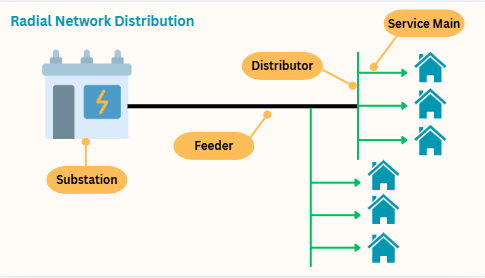
A radial network distributes electricity outward from a single point, like a main trunk line with smaller branches feeding various endpoints.
A radial power distribution system is a simple but fragile model where electricity flows outward from a single point. When a fault occurs on the main feeder, all premises on that line lose power, causing a large-scale disruption and lengthy outages while technicians locate and repair the fault. This one-way power flow also causes voltage to drop the farther it travels, resulting in fluctuating or insufficient voltage levels at the end of the line. The Ring Main Unit (RMU) provide the solution, changing the very architecture of power delivery from a brittle, single-path system to a robust and resilient looped network.
The RMU solution: The reliable power ring
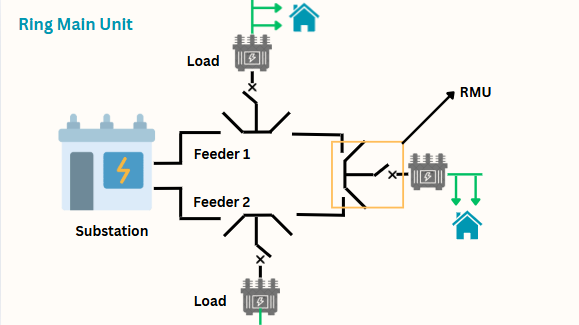
The RMU is a specialized electrical switchgear that eliminates the single point of failure inherent in radial networks by establishing a robust, looped network.
The Ring Main Unit (RMU) provides built-in redundancy by connecting to the power grid with two separate feeder cables, creating a built-in backup so if one feeder fails, the RMU can be supplied with power from the other side of the loop. When a fault occurs on the ring, the RMU's instantaneous fault isolation is activated as its internal protection relays act instantly to detect the problem, automatically opening switches on either side of the faulty section to isolate it and prevent the issue from affecting the entire network. With the damaged section safely isolated, the RMU can then perform automatic power rerouting, immediately pulling power from the healthy side of the loop, which prevents a blackout for everyone else connected to the ring, while also providing stable and consistent power by enabling power to flow from multiple directions, helping to stabilize voltage levels across the network and ensuring a consistent and higher-quality power supply for all, regardless of their location.
Beyond the switch: How the Remote Terminal Unit elevates RMU problem-solving
An RMU improves reliability by isolating faults, but as a standalone device, it has limited capabilities. An RMU has no communication capabilities, so it cannot report events or provide diagnostic data to a central control room, which delays response times. Furthermore, without external communication, operators lack a real-time overview of the network's status. Power restoration may require manual intervention if automated rerouting fails, leading to extended downtime. The Remote Terminal Unit (RTU) comes in, providing the RMU with a way to communicate and be controlled remotely.
The RTU solution: The communication and intelligence hub
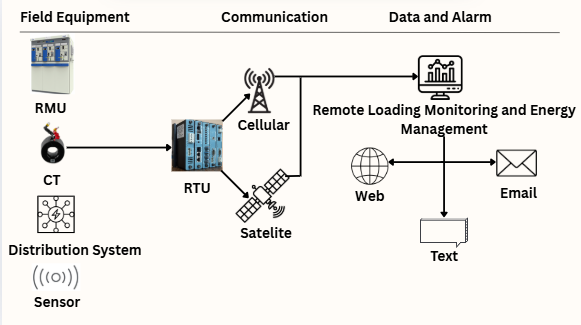
The RTU is a device that gives the RMU the ability to send and receive information.
By Integrating RMUs with RTUs, and a SCADA system significantly improves grid management. RTUs collect real-time data—like switch status and fault indications—and instantly communicate it to the SCADA control center via secure protocols. This enables operators to remotely locate faults and restore power, while automated 'self-healing' capabilities ensure a fast, coordinated response without human intervention. This integration also provides advanced analytics and historical data for improved network planning and predictive maintenance.
Enhancing Power Grid Reliability: The Role of Current Transformers
Performance considerations for Ring Main Units (RMUs) include environmental factors like moisture and dust, potential SF6 gas leakage, and the need for a reliable monitoring and protection system to prevent failures. While a Remote Terminal Unit (RTU) is an equipment for monitoring and controlling remote electrical substations, it doesn't directly solve issues within an RMU's physical structure; instead, an RTU is an equipment within the broader electrical network, enabling it to detect faults and perform control functions. Elmex low-voltage (LV) current transformers are used to accurately measure and transmit this current data to the RTU, enabling the system to react to problems like those potentially occurring within an RMU.
Elmex Metering CT: The bridge for precision
For modern power distribution, RMUs and RTUs require precise, safe, and reliable current measurement. The Elmex metering CT acts as a critical bridge, accurately stepping down high primary currents for measuring instruments in these vital systems. By enabling standard protection relays, energy meters, and other equipment to measure high current levels indirectly, it ensures safe and efficient operation.
Applications in RMU and RTU:
Key features:
Elmex protection CT: The cornerstone of safety
Elmex protection CTs reliably detect faults for safe electrical equipment operation by maintaining accuracy over a wide current range. This is achieved using a high knee-point voltage and a large core of high-saturation flux density material, which prevents saturation during high fault currents. The CTs are used with Protective Relays (PSR), Earth Leakage Monitoring Relays, Core Balance Current Transformers (CBCTs), and Circuit Breakers.
Applications in RMU and RTU:
Key features:
Elmex multi-core CT: The consolidated solution
For the complex and compact environments of RMUs and RTUs, a multi-core CT is a streamlined solution for managing multiple measurement and protection needs from a single unit. An Elmex multi-core CT integrates several independent magnetic cores within a single housing.
Applications in RMU and RTU:
Key features:
one device, providing flexibility to meet specific system requirements.
Core attributes:


